
That burning, shooting, sometimes electric sensation that starts in your lower back and travels down through your buttock, thigh, calf — maybe all the way to your foot. If you’ve felt it, you don’t need a medical dictionary to know something is wrong. That’s sciatica, and it’s one of the most common and most misunderstood sources of leg pain out there.
Let’s break down what’s actually happening and why it feels the way it does.
The Sciatic Nerve: A Quick Orientation
The sciatic nerve is the longest nerve in the human body. It originates from several nerve roots in your lower lumbar spine — the L4, L5, S1, S2, and S3 levels — and runs all the way down through the back of each leg to the foot.
When something irritates or compresses any part of that nerve, symptoms can show up anywhere along its path. That’s why two people with sciatica might describe completely different experiences. One person feels it in their hip. Another feels numbness in their toes. The nerve is long, and the irritation point determines where the signal gets disrupted.
What Actually Causes Sciatica?
Sciatica is a symptom, not a diagnosis on its own. Something upstream is putting pressure on or irritating the sciatic nerve. The most common culprits:
Herniated or bulging disc The discs between your vertebrae act as shock absorbers. When the soft inner material of a disc pushes outward — either bulging or fully herniating — it can press directly against a nerve root. This is the most frequent cause of true sciatica.
Degenerative disc disease As discs lose height and hydration over time, the space where nerve roots exit the spine can narrow. This is common in adults over 40 and doesn’t have to be dramatic to cause significant nerve irritation.
Spinal stenosis Stenosis means narrowing — in this case, of the spinal canal itself. When the canal gets too tight, the nerve tissue inside runs out of room. This tends to cause symptoms that worsen with walking or standing and improve when you sit or bend forward.
Piriformis syndrome The piriformis is a small muscle deep in the buttock. In some people, the sciatic nerve runs directly through or beneath it. If that muscle is tight or inflamed, it can compress the nerve — causing sciatica-like symptoms that originate in the hip rather than the spine.
Bone spurs or joint changes Arthritic changes in the facet joints — the small paired joints at the back of each vertebra — can create bone spurs that encroach on nerve space over time.
Why Sciatica Feels So Unpredictable
Most pain follows a predictable pattern. Sciatica doesn’t always play by those rules. Some people find it worse when sitting. Others feel it most when standing up after rest. Bending forward might relieve it, or might make it unbearable. Certain sleeping positions help; others are miserable.
This variability isn’t random — it reflects the specific cause, the specific nerve level involved, and how your body is compensating. Two people with “sciatica” may need completely different approaches, which is why getting an actual diagnosis matters before trying to treat it.
What Sciatica Feels Like (and What Gets Confused with It)
Classic sciatica tends to affect one leg at a time. Common descriptions include:
- A deep, aching pain in the buttock or back of the thigh
- Sharp or burning pain that shoots down the leg
- Numbness, tingling, or a “pins and needles” sensation
- Muscle weakness in the leg or foot
- Pain that’s worse with prolonged sitting
Bilateral symptoms — both legs at once — or loss of bladder and bowel control are red flags that need immediate medical attention. That scenario is outside the scope of what a chiropractic clinic should manage, and any reputable provider will tell you the same and send you where you need to go.
How the Right Exam Changes Everything
At The Spinal Decompression & Chiropractic Center, Dr. Baugher doesn’t guess. Before any treatment plan is discussed, he runs a thorough evaluation: orthopedic tests, neurological tests, range-of-motion assessment, and X-rays when the clinical picture calls for them.
Dr. B has a simple standard for how he explains findings: “put the hay down where the goats can get it.” That means no unnecessary jargon, no vague reassurances, no brushing past the hard questions. You’ll leave knowing what’s actually going on in your spine and why your leg hurts the way it does.
If the exam shows that the clinic isn’t the right fit — say, a surgical consult is clearly needed — he’ll tell you that directly and point you toward the right resource. That’s been part of how this practice has operated since 1998.
What Care for Sciatica Might Look Like
For qualifying conditions, non-surgical options may help address the underlying source of nerve compression. Depending on what’s driving the problem, a treatment plan at this clinic might include:
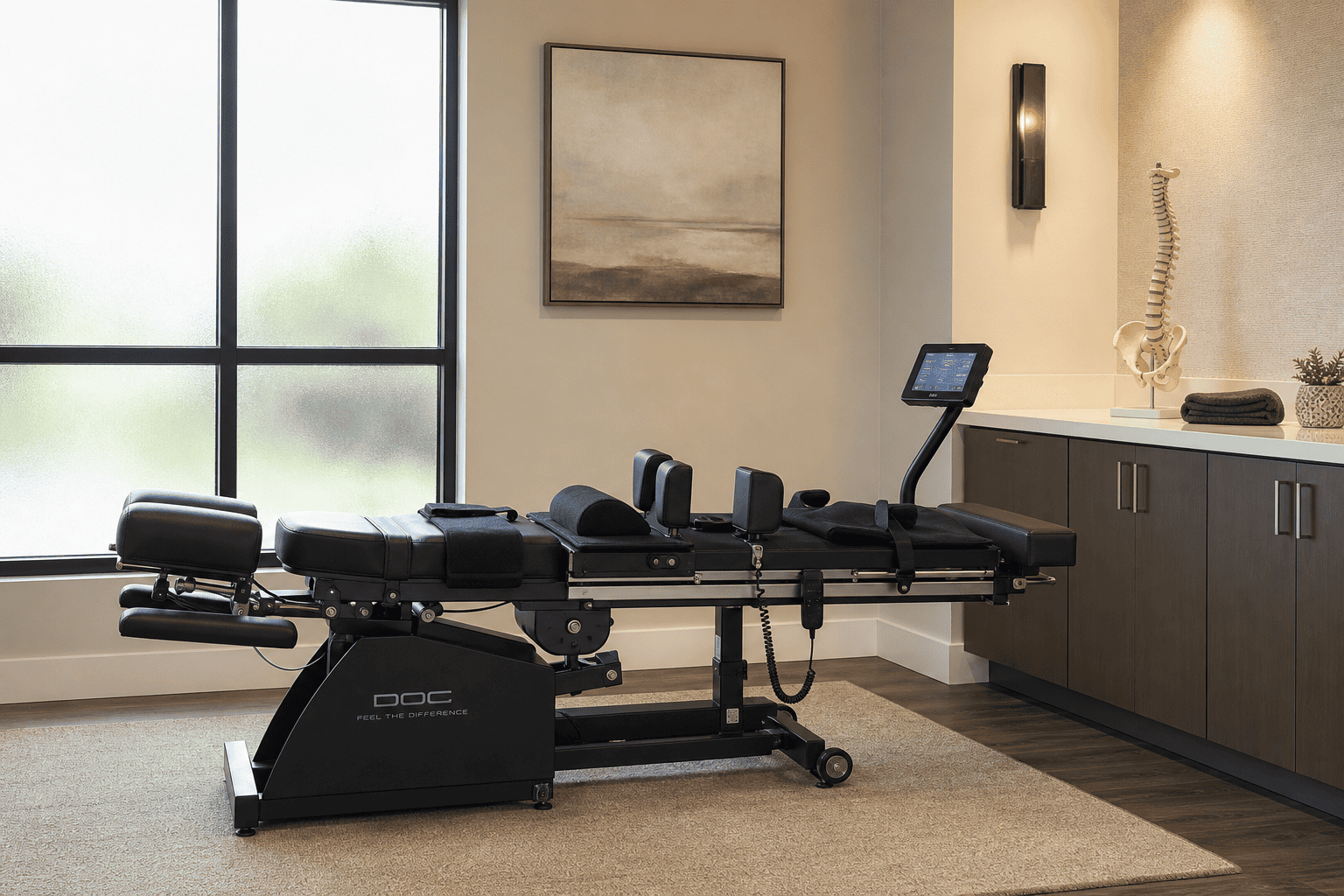
- Spinal decompression therapy — designed to gently reduce pressure on compressed discs and nerve roots
- Chiropractic adjustments — to restore proper joint mechanics in the lumbar spine and pelvis
- Cold laser therapy — low-level light therapy that may support tissue-level healing and reduce inflammation
- Shockwave therapy — for soft tissue involvement, including piriformis-related cases
These aren’t à la carte services — they’re coordinated as part of a personalized plan built around your specific findings.
The clinic is cash-based and can provide superbills for patients who want to submit for potential insurance reimbursement.
—
Frequently Asked Questions
Can sciatica go away on its own? Sometimes, yes — especially if it’s caused by a mild disc bulge that resolves with rest and movement. But when symptoms persist beyond a few weeks, worsen, or include numbness and weakness, waiting it out isn’t a great strategy. Getting a clear picture of what’s causing it helps you make an informed decision.
Is sciatica the same as a herniated disc? Not exactly. A herniated disc is one common cause of sciatica, but sciatica refers to the nerve irritation and its symptoms. Other conditions — stenosis, piriformis syndrome, joint changes — can produce the same leg pain without a disc herniation being involved.
How do I know if I need surgery? Most cases of sciatica respond to conservative, non-surgical care. Surgery is typically considered when there’s significant or worsening neurological deficit — loss of muscle function, severe weakness — or when conservative treatment has been given a genuine trial and hasn’t helped. A good clinician will be honest with you about where on that spectrum you fall.
—
If that familiar pain down your leg has been hanging around, a conversation is a good place to start. You can reach The Spinal Decompression & Chiropractic Center in Denton to ask questions or schedule an evaluation — no pressure, just answers.