

Most people wait longer than they should.
You tweak something lifting groceries, sleep wrong, or just wake up stiff one morning. You figure it’ll pass. You stretch a little, maybe take some ibuprofen, and keep going. Sometimes that works. But sometimes the pain doesn’t go away. It shifts, spreads, or quietly gets worse while you keep telling yourself you’ll deal with it next week.
If that sounds familiar, this post is for you.
Some Back Pain Is “Wait and See.” Some Is Not.
Not every ache needs an appointment. Mild muscle soreness from overdoing it at the gym or in the yard often resolves on its own with rest and gentle movement. But there’s a difference between that kind of pain and the kind that’s telling you something is actually wrong.
The tricky part is that back pain doesn’t always announce itself dramatically. Sometimes a significant disc problem starts as a dull ache that you write off for months before it finally becomes impossible to ignore.
Here are signs it’s time to stop waiting and get a real evaluation:
- Pain that lasts more than a few weeks without improvement
- Pain that radiates down your leg, hip, or into your foot (this may signal nerve involvement)
- Numbness, tingling, or weakness in your legs or feet
- Pain that wakes you up at night
- Pain that gets worse with sitting or during specific movements like bending or sneezing
- Pain that followed an injury, even one that seemed minor at the time
- Any loss of bladder or bowel control (this warrants an emergency room visit, not a chiropractic office)
That last one is worth stating plainly: if you have any loss of bladder or bowel function alongside back pain, go to the ER. There are conditions that require immediate surgical intervention, and knowing that boundary is part of how we take care of people well.
What a Real Evaluation Actually Looks Like
One of the most common things people tell us is that they’ve been living with pain for a long time but nobody ever really examined them. They got a quick appointment, maybe an X-ray referral, and a prescription for something to manage the symptoms.
At The Spinal Decompression and Chiropractic Center, the first step before any treatment is a thorough exam. That means orthopedic and neurological tests, range-of-motion assessment, and X-rays when they’re clinically appropriate. The goal is to understand what’s actually happening in your spine, not just treat the symptom you walked in with.
Dr. B’s approach has always been to “put the hay down where the goats can get it.” That means explaining what he finds in plain language, so you actually understand your own situation before any decision gets made.
If we’re not the right fit for what you’re dealing with, we’ll tell you. We refer out when that’s the right call, because the goal is to get you better, not to fill a schedule.
When Back Pain Points to a Disc Problem
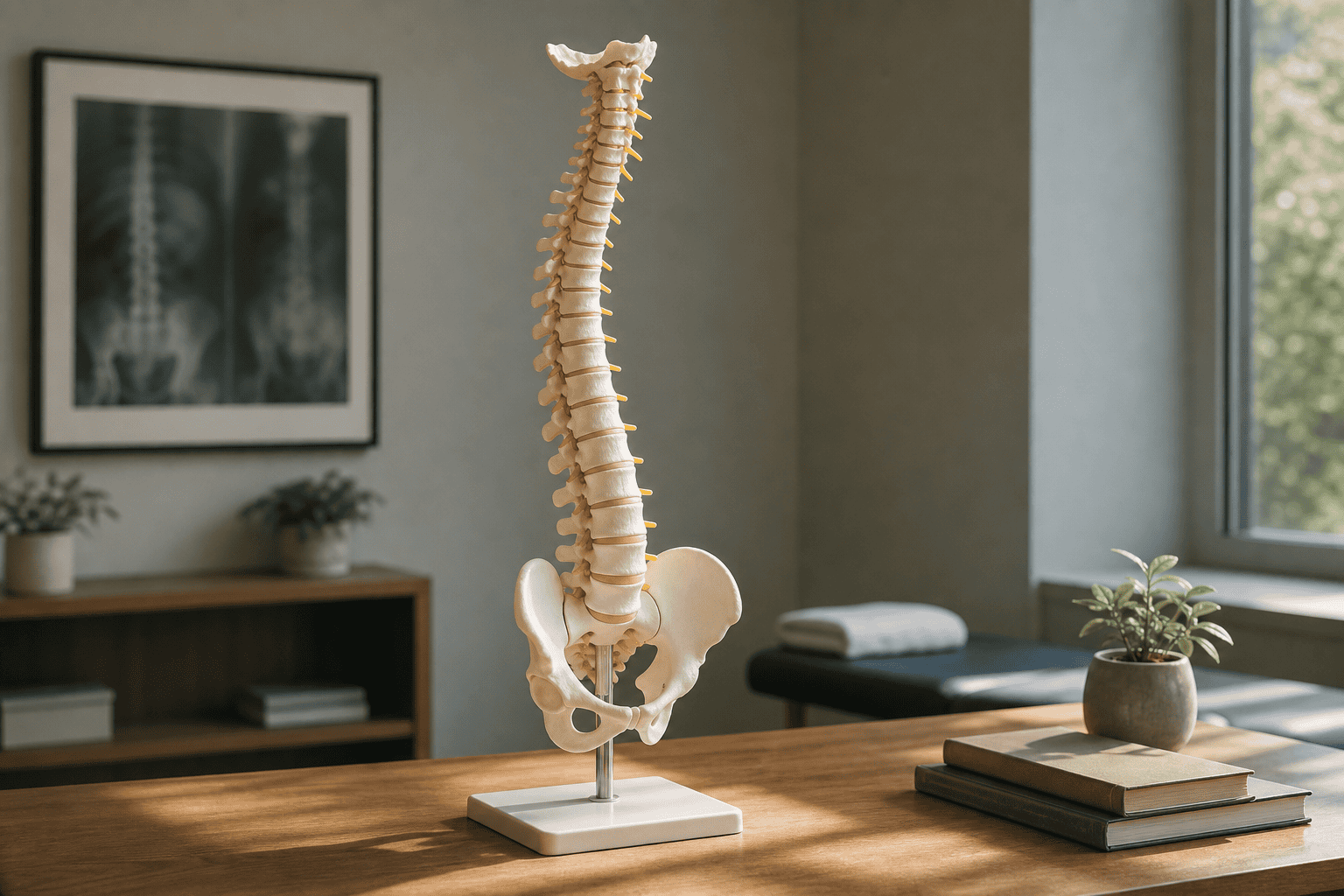
A lot of the back pain we see in Denton, and in communities like Flower Mound, Argyle, and Corinth, turns out to involve a disc. The discs are the cushioning structures between your vertebrae, and they’re more vulnerable than most people realize. They can bulge, herniate, or lose height over time, and when they do, they can press on nearby nerves.
That’s why back pain sometimes travels. When a disc irritates a nerve root, you may feel it in your hip, your thigh, your calf, all the way down to your toes. That pattern is called radiculopathy, which just means pain or symptoms that radiate along a nerve pathway.
Chiropractic adjustments can relieve some of the stress around an injured disc. Better motion, less muscle guarding, less nerve irritation. But in Dr. B’s experience working through case after case of disc problems, that relief tended to be temporary. It wasn’t until he incorporated spinal decompression that he started seeing disc patients get lasting results.
Spinal decompression works differently. Using a computerized decompression table, the computer does the work of creating a gentle, precise reduction in pressure inside the disc. Dr. B describes it as trying to “suck the jelly back in and pump nutrition into the disc.” More precisely, the reduction in pressure creates a vacuum-like effect that may help draw bulging or herniated material back toward the center of the disc. The repeated loading and unloading also helps pump water and nutrients into the disc tissue, which has a poor direct blood supply and struggles to heal on its own.
For qualifying conditions, this approach is designed to address the disc itself, not just manage the symptoms around it. It’s the core of what we do, built into a personalized treatment plan rather than offered as a one-off session.
You Don’t Have to Figure This Out Alone
If you’ve been holding out hope that the pain will just go away, that instinct makes sense. But the longer a disc or nerve problem goes unaddressed, the harder it can be to work with. Waiting doesn’t usually make these things better, and it sometimes makes them harder to treat.
Over more than 20 years and 8,000+ patients, we’ve seen what a difference it makes when someone finally gets a proper look at what’s going on. People come in from Denton, Highland Village, Lantana, The Colony, and all over the area because they’re tired of managing pain without answers.
The first step is just a conversation and an honest exam. If treatment is appropriate and you qualify, it can start that same day.
—
Frequently Asked Questions
How do I know if my back pain is a muscle problem or a disc problem? Muscle strain usually improves within a few weeks with rest. Disc problems often involve pain that travels (down the leg, into the hip, or foot), pain that worsens with sitting or specific movements, and symptoms like tingling or numbness. A thorough exam, including orthopedic and neurological testing, is the most reliable way to tell the difference.
Is chiropractic care alone enough for a disc problem? It depends on the severity. Adjustments can help reduce tension and discomfort around an injured disc, but they don’t address the disc itself. For significant disc involvement, spinal decompression is typically the main treatment in our plans, with adjustments supporting the surrounding structures.
What if I’ve already tried chiropractic care and it didn’t help? That’s actually one of the most common things we hear. Traditional chiropractic can be very effective for many conditions, but for disc problems specifically, decompression often produces results that adjustments alone don’t. If you’ve been through care that didn’t get you where you needed to be, it may be worth finding out whether you’re a candidate for a different approach.
—
If you’re dealing with back pain that isn’t going away, a conversation is a good place to start. Reach out to our Denton office and we’ll take an honest look at what’s going on.